Ask Naiasno: a new way to explore Bulgaria’s public data
Published: 2026-09-10
Starter questions and conversation about prices, budgets and public data. How the two modes work, how to check answers and where their capabilities end.
What do basic groceries cost in Plovdiv? What did the state plan to spend, and what has it reported so far? How do you move from a procurement total to a particular procedure? Ask Naiasno lets you start with a question and brings together ready-made queries, tables and charts from the site’s data.
Ask your first question. You can start without AI or an AI access check. Choose a starter question or type your own. When you want more flexible wording and an explanation, select the AI assistant from the mode menu.
The chat is now part of the main site, alongside its tools and detailed dashboards. Naiasno is the project’s new name, and since 11 September the site lives at naiasno.bg — old electionsbg.com addresses redirect automatically. The chat’s path remains /chat.
What can you ask about?
Starter questions are grouped around practical interests: prices and household spending; budgets, taxes and procurement; elections, parliament and local government; population and living conditions; health, education, pensions and social support. There are also queries about EU funding, agriculture, companies and declared interests, energy, the environment and other areas.
This does not mean that every question about these subjects has an answer. Each query has a particular dataset, period and geographical scope. Information being available somewhere on the site also does not mean that the chat can already retrieve it from any wording.
Explore the tools catalogue and data sources page. There you can see where the information comes from—for example, the Central Election Commission, Ministry of Finance, National Statistical Institute and Public Procurement Agency. The chat helps you find a query; its source and methodology explain what it measures.
Starters, your own questions and follow-ups
The easiest starting point is Topics → Subtopic → Question. Choose what interests you, and the starter supplies the parameters for the appropriate query. You can also type in the composer. Naming the place, year, institution or procedure number helps.
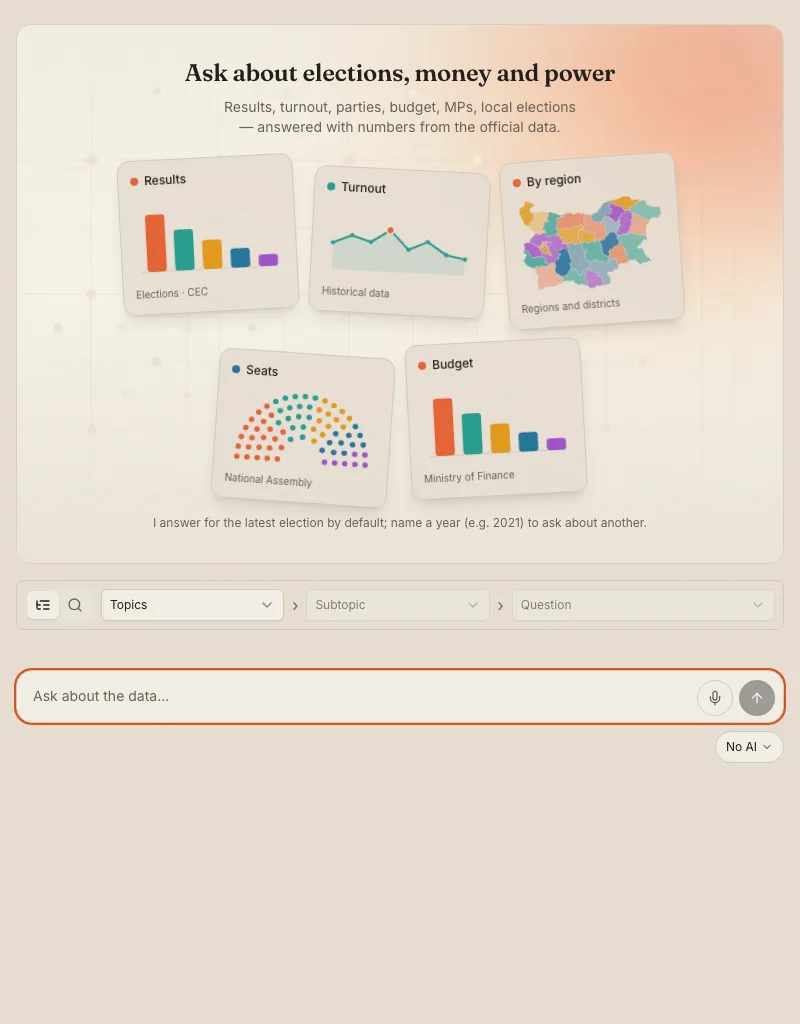 1. Starter question Choose a topic, subtopic and question. 2. Your own question Type a specific question with a place or year. 3. Mode No AI is the initial mode; select AI from the menu.Open full size
Below each answer are several suggested follow-up or clarifying questions. They help you continue to another query. You can type a follow-up too, but a short “and there?” or “and before that?” is not always understood correctly. If the answer changes the place or period, repeat them explicitly. When in doubt, choose a starter or open the corresponding dashboard.
Three questions to begin with
Prices in your town. “What are the prices in Plovdiv?” shows selected products, their lowest and average prices, and a chain with the lowest reported price. In our check, the observations were dated 8 September 2026. That is the observation date, not this article’s date.
Read the product description too: “bread, 500g to 1kg” does not represent an identical package in every record. A quoted price does not guarantee availability in every shop today. The basket is consumer-protection monitoring, not the official Consumer Price Index. Use it for orientation, then check the particular product and retailer.
Budget plan and execution. “What is the state budget — plan and actual spending?” returns two different columns. The example shows €34.5bn in planned annual expenditure and €16.5bn recorded through 31 July 2026. Seven months of execution are not a full-year account; that difference alone does not demonstrate savings or failure to deliver.
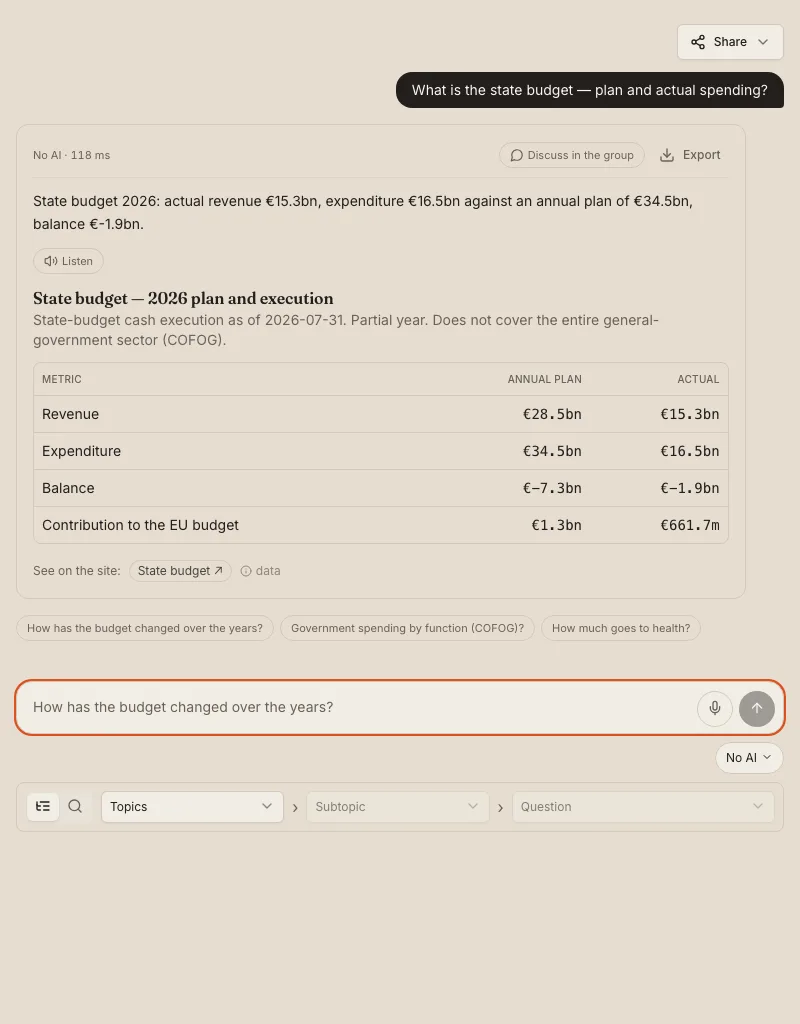 1. Period and scope Actual spending runs to 31 July 2026, not the full year. 2. Two different columns Annual plan and recorded execution are different measures. 3. Check the evidence Open the budget dashboard and data sources page.Open full size
This query covers the state budget, not the whole general-government sector. Its balance also subtracts the contribution to the EU budget. Open the budget dashboard for the scope and details.
Seats in parliament. “How many seats does each party hold in parliament?” shows the allocation of 240 seats from the 19 April 2026 election. The date matters: this is the election allocation, not a promise of a live faction-membership list after every departure or change.
No AI and the AI assistant
In No AI mode, starters and recognized wording invoke purpose-built tools. These retrieve data, perform calculations and arrange the results. The short explanation follows a template. No language model (AI) is used for that response, but fetching data still needs an internet connection.
In AI mode, the model helps interpret the question and explain the tools’ results. Your question and conversation context are processed in the cloud with Google Gemini. Tables and charts come from the tools; the free-form narrative around them needs a separate check. AI can miss a qualification, choose an unsuitable query or make an unsupported inference.
For example, you can ask about the budget: “State the reporting period and explain the difference between plan and execution.” In our Bulgarian test, AI identified the correct period and figures. That is one useful explanation, not a guarantee that every later response will be correct. Compare the numbers with the table and open the source when in doubt.
Two deeper checks
From a topic to a procedure. “Show me all road-guardrail tenders in 2025” searches the available corpus for that topic and year. “All” in the starter does not guarantee completeness outside the corpus’s coverage. Our checked response contained two procedures.
Select the suggested “Show tender 00044-2025-0125”. Its details include the buyer, date, six lots and an estimated value of approximately €490.8m. This is an announced estimate, not a payment. The status is also the one held in the available data, not an independent confirmation of today’s position.
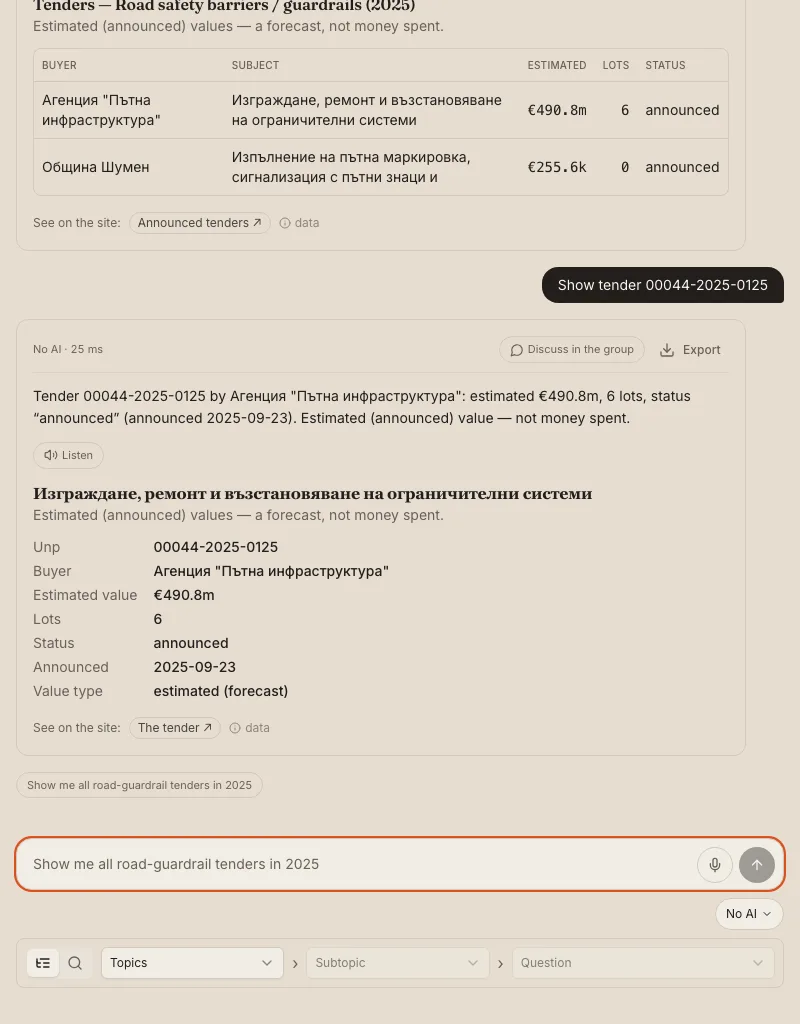 1. Next question The suggested question opened a particular procedure. 2. Meaning of the amount This is an estimated value, not a payment. 3. Open the record The link opens the procedure details.Open full size
Open the procedure, read its records and follow the original source. A query finding no contract does not prove that none exists in another source.
A polling section over time. “How has section 050900092 voted over the years?” shows a series across 12 elections for the section labelled Inovo in the data. Use the section dashboard to check individual elections. An unchanged code does not prove unchanged voters or boundaries. Parties and coalitions change too; a gap in a series is not automatically a zero result.
Missing data, verification and limits
Try “What is the state budget in 2027?”. In our check, the chat stated that 2027 data were unavailable and displayed 2026 instead. The warning appears below the query title; the opening sentence describes the displayed 2026 figures. This is a fallback query, not a forecast for 2027. Read the title, period and coverage, not only the first sentence.
AI access uses Cloudflare Turnstile to check for automated abuse. Verification may repeat when the session expires. Current limits allow up to 20 question starts per verified session per day, 60 per IP address per day, and 3 during the last 60 seconds per session. A session lasts one hour. Daily accounting renews at 00:00 UTC, not local midnight.
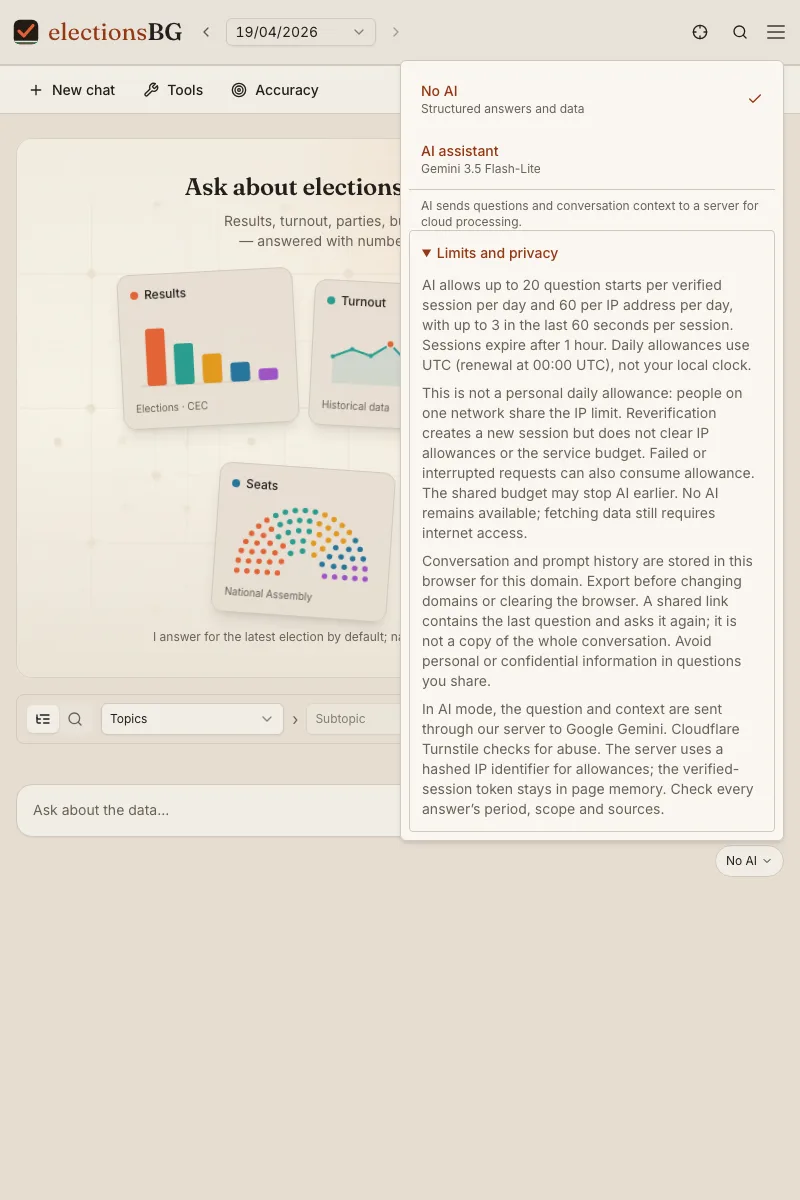 1. Choose a mode AI processes the question and context in the cloud. 2. Shared limits Session and IP allowances are separate. 3. History and sharing History stays in the browser; a link re-asks the last question.Open full size
This is not a personal daily allowance: people sharing a network share the IP limit. Reverification does not reset that limit or the service’s shared budget. Failed or interrupted requests can consume allowance, and the shared budget may temporarily stop AI earlier. When the AI request limit is exceeded, you can continue in No AI mode, although data or network failures can prevent that mode from returning a query too.
The chat conversation and prompt history stay in the browser for the current domain. A shared link contains the last question and asks it again; it does not preserve the whole conversation or a historical answer. Do not share a context-dependent question such as “and in 2023?” on its own.
How it compares with other AI systems
Different tools suit different tasks. This comparison was checked on 10 September 2026 and is not an accuracy ranking.
| Tool | Useful approach and checked status |
|---|---|
| Ask Naiasno | Dedicated queries over the loaded Bulgarian datasets, with tables, charts and dashboard links. The examples here have specific coverage; free-text questions have limitations. |
| ChatGPT | Broader web search and explanation with source controls. In our small test it retained follow-up context and displayed a table and chart. This does not certify every answer’s accuracy. |
| Perplexity | Documents web search, cited answers and contextual follow-ups. Our anonymous session requested sign-up before answering; conversational tasks were not assessed. |
| Data Commons | Maps natural language to sourced structured statistics. We received dated charts; the short “and in 2023?” in its search field did not resolve a place. It also offers suggested related questions. |
| СИГМА | A specialist public procurement portal with a documented AI assistant design covering Bulgarian text and voice. We found no chat on the inspected homepage and do not treat planned features as tested live capabilities. |
Specialist search tools such as OpenTender Bulgaria and BIRD’s declaration search can help with particular checks too. Compare periods, units and original sources before comparing totals between sites.
Open Ask Naiasno and begin with one concrete question. If an answer is unclear or wrong, use the community link beneath it and identify the question, mode and mismatch with the source—without personal or confidential information.
To report a bug or suggest a feature, open an issue in the project’s GitHub repository.